The Entropy of The Long Walk a Liminal Paradise
- Rob L K Wood
- May 13
- 3 min read
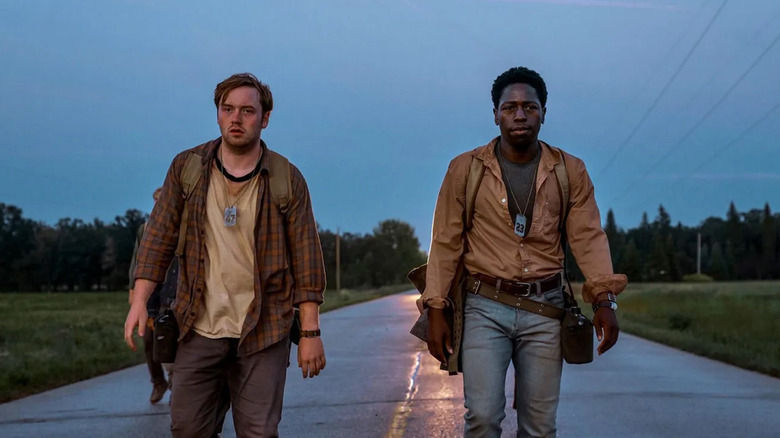
Stephen King’s The Long Walk is often read as a dystopian survival story. But that framing doesn’t fully capture what makes it so unsettling. The novel isn’t just about endurance or violence—it’s about existing in a strange, suspended state where identity, time, and even life itself begin to blur.
One way to get at that feeling is through an unexpected lens: Schrödinger's cat—and, more fundamentally, Entropy.
In Schrödinger’s famous thought experiment, a cat in a sealed box is both alive and dead until observed. It exists in a state of superposition—multiple realities at once.
The boys in The Long Walk seem to occupy something eerily similar. As long as they keep walking, they are alive. But death is not a distant possibility—it is built into the structure of the event. Every step is taken under the shadow of an inevitable outcome.
They are:
alive, because they are still moving
functionally dead, because the system guarantees their end
Each moment reopens the “box.” Each step says: not yet. But never not soon.
The comparison works on an emotional level. The walkers feel suspended between states, reduced to something provisional and unstable. Their existence is conditional, constantly on the verge of collapse.
But the analogy isn’t perfect—and that imperfection matters.
Schrödinger’s cat is about uncertainty: we don’t know whether the cat is alive or dead.
The boys are different. Their fate isn’t uncertain—it’s inevitable. The only variable is when.
So instead of being both alive and dead, they are something more disturbing:
alive while already condemned
This isn’t superposition. It’s a slow, stretched-out certainty.
If Schrödinger gives us the feeling, entropy gives us the mechanism.
In thermodynamics, entropy describes the tendency of systems to move from order to disorder—to expend energy, to break down, to become less structured over time.
That is exactly what the Walk enforces.
Each boy begins as a coherent system:
a body with reserves
a mind with identity
a sense of self anchored in the past
But step by step, mile by mile, that structure degrades.
Muscles fail
thoughts fragment
language loosens
personality dissolves
Energy is burned with no possibility of recovery. There is no rest state, no reset, no equilibrium—only continuous expenditure.
The Walk is a closed system designed to maximize entropy.
What makes The Long Walk feel so haunting is its setting: an endless American highway that is neither a beginning nor an end.
The boys are cut off from ordinary life:
not at home
not in a traditional battlefield
not fully part of society anymore
They move through towns, but never arrive anywhere. The landscape blurs. Time loses structure. Sleep deprivation and exhaustion fracture perception.
The road becomes a liminal corridor—a space of transition with no resolution.
In that space, identity erodes. The boys stop being sons, students, or individuals. They become roles:
the strong one
the joker
the rebel
the one who breaks
They are no longer people so much as systems losing coherence in public.
The walk is not just a death march—it’s a performance.
Crowds gather. Spectators cheer. The state enforces rules with ritual precision. The Major presides like a director or ringmaster, shaping the rhythm of the event.
Suffering becomes something to watch.
This is where the novel feels uncannily modern. The walkers are always visible, always consumed. Their personalities are flattened into narratives the audience can follow.
They are not just dying—they are being seen while they degrade.
If Schrödinger’s cat doesn’t quite fit, and entropy does, then the boys are best understood not as dual states—but as trajectories.
Each one is a curve trending downward:
energy → exhaustion
coherence → fragmentation
self → absence
There is no victory condition except being the last to disintegrate. Survival is just postponed collapse.
That’s what gives the novel its liminal quality. The boys aren’t moving toward a meaningful future. They are moving through a stretched present, one that is constantly erasing them.
They become neither alive nor dead, but something in between:a body in motion, already disappearing
The Long Walk lingers because it turns existence into a visible process of breakdown. It replaces stability with fragility, identity with erosion, and narrative with inevitability.
Entropy doesn’t just describe the physical decline of the walkers—it mirrors the collapse of meaning itself.
What begins as a structured event—a contest, a spectacle, a system with rules—slowly reveals its true nature:
a machine for converting human life into disorder.
And once that idea takes hold, it’s hard to shake.
Because the real horror isn’t just death—it’s the certainty that, given enough time, everything—body, mind, self—will come apart.
The Walk just makes that process impossible to ignore.


Comments